158. Oncoming Vehicle evaluation scenario
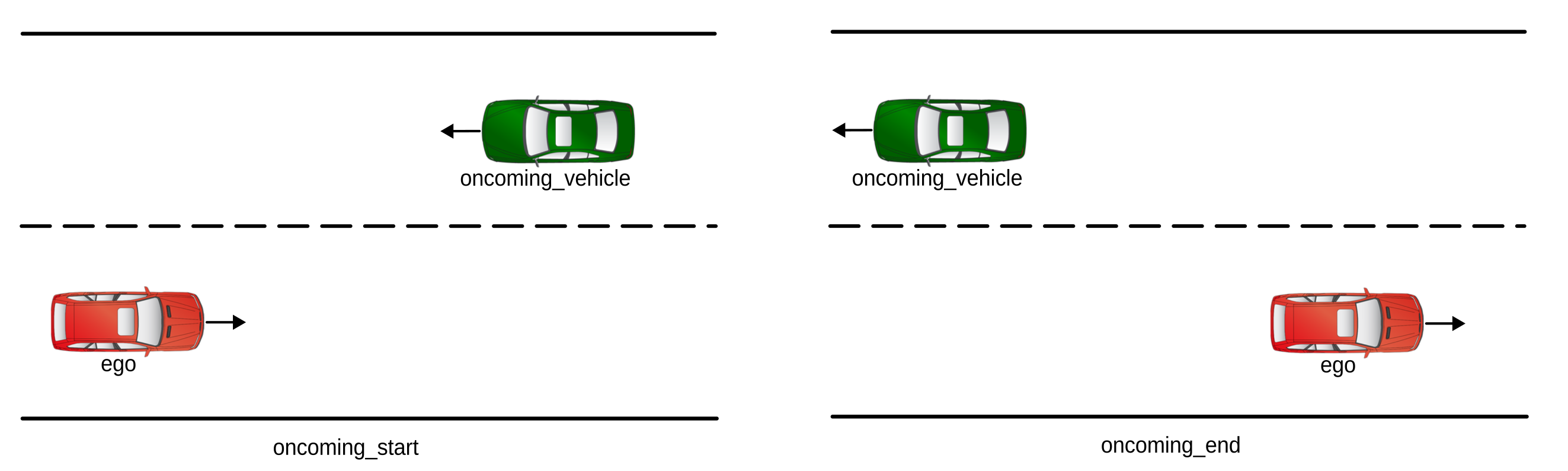
In the oncoming_vehicle evaluation scenario, the vehicle_actor drives in the oncoming lane adjacent to the Ego in the outgoing lane.
Scenario location: $FTX/logiq/scenario_library_post_match/oncoming_vehicles/oncoming_vehicle
158.1 Actors
The actors associated with this scenario are as follows:
| Actor | Description | Type | Depiction |
|---|---|---|---|
ego |
Vehicle under test | vehicle |
 |
vehicle_actor |
Oncoming vehicle | vehicle |
 |
158.2 Scenario phases
The phase descriptions are as follows:
158.2.1 oncoming_phase
Ego: The Ego drives in the outgoing lane.
vehicle_actor: The vehicle_actor drives in the oncoming lane adjacent to the Ego, and maintains a
distance of at least max_distance_from_ego from the Ego.
158.3 Parameters
Use these parameters to constrain the scenario. If you do not set a specific value, the default value will be used.
| Parameter | Type | Description | Default value |
|---|---|---|---|
min_distance_from_ego |
length | Minimal geometric distance from the Ego to the oncoming vehicle during the entire scenario | 0m |
max_distance_from_ego |
length | Maximal geometric distance from the Ego to the oncoming vehicle during the entire scenario | 80m |
min_oncoming_phase_duration |
time | The minimal duration of the oncoming_phase phase |
0.5s |
max_oncoming_phase_duration |
time | The maximal duration of the oncoming_phase phase |
8s |
The input items inherited from the sut.logiq_base_vehicle_scenario scenario are as follows:
| Parameter | Type | Description | Default value |
|---|---|---|---|
kinds |
list of evaluation_object_kind | The possible kinds of vehicle_actor in the scenario | No default value |
158.4 Metrics
158.4.1 Coverage
[Click] The coverage items inherited from the sut.logiq_base_vehicle_scenario scenario are as follows:
| Item | Description | Range | Unit/Type |
|---|---|---|---|
vehicle_speed_at_start |
Agent speed at start of the scenario | [0..150), every: 10.0 | mph |
[Click] The coverage items inherited from the sut.logiq_base_scenario scenario are as follows:
| Item | Description | Range | Unit/Type |
|---|---|---|---|
ego_speed_at_start |
Ego longitudinal speed at the start of the scenario | [0..160), every: 10.0 | mph |
158.4.2 KPI
[Click] The KPIs inherited from the sut.logiq_base_vehicle_scenario scenario are as follows:
| Item | Description | Range | Unit/Type |
|---|---|---|---|
vehicle_object_kind |
Object kind as derived from Foretify | object, person, cyclist, vehicle, truck, trailer, fod, animal, sign, bus, motorcycle, emergency_vehicle, stationary_vehicle | evaluation_object_kind |
vehicle_tracking_id |
The tracking id of the agent as described in the object list data. If the data comes from a generative run, the UID will be used | string | |
vehicle_avg_speed |
Agent average longitudinal speed throughout the scenario | mph | |
vehicle_max_speed |
Agent maximum speed throughout the scenario | mph | |
vehicle_min_speed |
Agent minimum speed throughout the scenario | mph | |
vehicle_max_lon_acceleration |
Agent maximum longitudinal acceleration throughout the scenario | mpsps | |
vehicle_min_lon_acceleration |
Agent minimum longitudinal acceleration throughout the scenario | mpsps | |
ego_min_ttc_to_vehicle |
Minimal time to collision with the reference vehicle throughout the scenario | s | |
ego_min_mttc_to_vehicle |
Minimal modified time to collision with the reference vehicle throughout the scenario | s |
[Click] The KPIs inherited from the sut.logiq_base_scenario scenario are as follows:
| Item | Description | Range | Unit/Type |
|---|---|---|---|
ego_max_lon_acceleration |
Ego maximum acceleration throughout the scenario | mpsps | |
ego_min_lon_acceleration |
Ego minimum acceleration throughout the scenario | mpsps | |
ego_min_speed |
Ego minimum longitudinal speed throughout the scenario | mph | |
ego_avg_speed |
Ego average longitudinal speed throughout the scenario | mph | |
ego_max_speed |
Ego maximum longitudinal speed throughout the scenario | mph | |
interval_duration |
Interval duration of the scenario | s |